A passive affiliate channel, turned into a self-running creator engine.
An Amazon seller had years of affiliate revenue from creators it had never once contacted — money on autopilot, nobody managing the relationships. I built the AI system that finds, researches, pitches, equips, and tracks creators almost end-to-end. It runs in production, and it's already pulling in creator content.
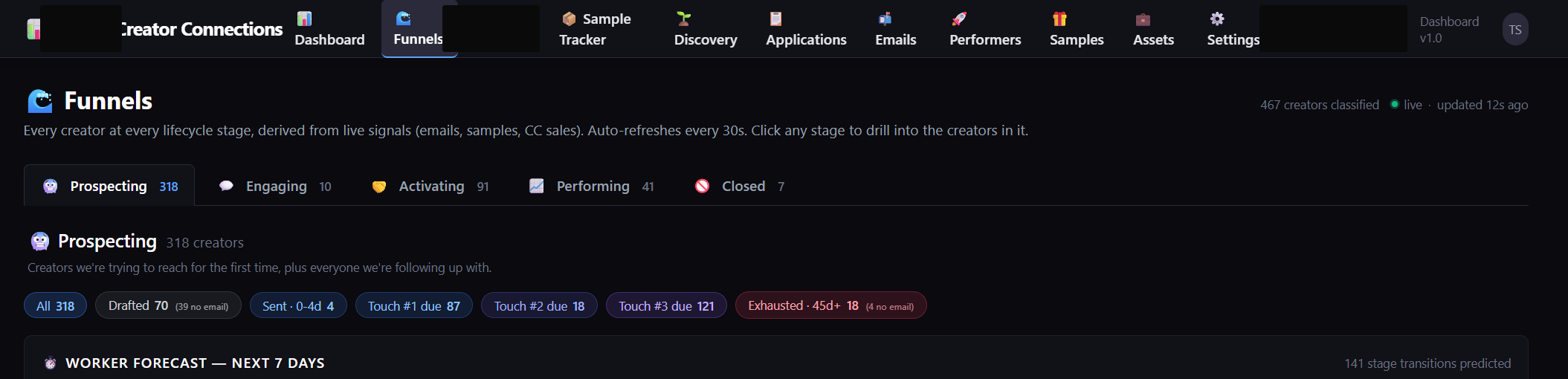
The bottleneck
A multi-brand Amazon seller had a quietly valuable asset it was completely ignoring: a large roster of creators who'd been driving affiliate sales for years. Nobody had ever reached out to a single one. Creators found the products on their own, posted, earned — and the channel just sat there, unmanaged, leaving obvious money on the table.
The fix is simple to say and brutal to do by hand: actually manage these relationships. Find the proven performers. Reach out personally. Send samples. Track who converts. Follow up. Recruit new creators on top. Do that across hundreds of people and it's a full-time team. So I built the team as software instead.
The system, stage by stage
It runs as a pipeline — most stages automated, with me kept in the loop only where human judgment actually earns its keep (negotiation, edge cases, voice).
- Sourcing. Pulls creators from three streams — proven past performers, inbound partnership applications, and a discovery crawler that surfaces active creators with real audiences.
- Research & enrichment. For each creator it gathers performance history, storefront signals, niche, and audience fit, then scores them so outreach hits the highest-leverage people first.
- Personalized outreach, drafted by AI. A genuinely tailored first-contact email per creator — matched to their niche, with a fitting product recommendation and terms — not a mail-merge blast.
- Rate-limited send queue. Emails dispatch through a queue that respects strict per-hour and per-day limits with human-like spacing, so the channel stays deliverable and never looks like spam.
- Reply ingestion & threading. Incoming replies are pulled in automatically and stitched into the right conversation, so nothing falls through the cracks and the whole history lives in one place.
- Sample logistics. When a creator's in, the system assembles a fitting sample kit, captures and validates the shipping address, and tracks the shipment through to delivery.
- Performance tracking. It captures clicks, orders, and sales per creator per campaign — so the brand finally knows which relationships drive revenue, not just which ones reply.
- Autonomous follow-up. If someone goes quiet, the system nudges — reminders, address requests, second touches — on its own schedule, so momentum never depends on anyone remembering.
What it's built on
This isn't a no-code toy or a one-off script. It's a real application: a Python/Flask service backed by a database, browser automation for the data the platform won't hand over through an API, and a proper email integration for sending and receiving at scale — running continuously on its own server, not on my laptop. The kind of thing that keeps working whether or not I'm watching it.
Doing this by hand — researching each creator, writing a real personalized pitch, chasing replies, arranging samples, logging performance — is hours of work per creator. The system does the repetitive 90% and hands me only the decisions worth a human. That's headcount replaced with a system.
Three things a VA can't do
The pipeline above is the visible part. Underneath it are three capabilities that separate an automation from an operating system — the parts a brand would normally staff an analyst to do, and usually just doesn't. Jump to: sample ROI · the control tower · the self-writing report.
1 · It tells you whether the free product paid for itself ★
Seeding free product is a real cost, and almost nobody measures it honestly. The hard question — did this kit convert into sales? — usually goes unanswered because it's tedious to reconcile. This system nets the cost of each sample (product plus fulfilment) against the sales those same creators drove after their ship date, for any date window and broken out per product. So instead of "we sent 40 kits," you get "seeding this SKU earns its cost back and that one doesn't — seed accordingly."
Stated honestly: the figure is treated as an upper bound and flagged provisional until every kit's cost is on file — the system refuses to flatter its own numbers. A VA logs which samples went out. This measures whether the spend worked.
2 · One control tower for every automation
A platform like this runs on dozens of unattended jobs overnight — sourcing, enrichment, inbox sync, dispatch, reporting. A solo operator can't babysit them, and a silent failure is the dangerous kind: it rots data for days before anyone notices. So there's a single control-tower screen that shows every scheduled job grouped by function — status, last run, next run, live logs — self-heals stale "running" states so the dashboard never lies about a dead process, raises an alert when something breaks, and offers one-click "run now."
The job count grew from 3 to roughly 25 as the platform expanded — a system that compounded, not a one-off script. A failure pages me instead of quietly costing a week.
3 · The weekly report writes itself
The last screen is the one that makes it an operating system rather than a pile of automations. It answers the only three questions that matter at a glance — where do we stand, what needs me today, is anything broken — with the north-star number against target, the full funnel with week-over-week movement, a "needs me" action queue, and a system-health panel. Then it generates a copy-paste weekly summary for the leadership update. Every number on it is a live query — if it says eleven conversations are waiting on a reply, the data says eleven, not a stale cell someone forgot to update. A nightly checker repairs any drift across the system before it can mislead.
This is the concrete version of the thing the word "system" is supposed to mean: a live scorecard and an operating cadence, running itself. It's the same instinct as the ledger on the ads side: governed automation, not a black box.
Most Amazon brands haven't even switched this on
Here's the part most sellers miss: Amazon's creator/affiliate channel is free, incremental revenue. Creators promote your products; you pay commission only on the sales they actually drive — no ad spend, no inventory risk. Yet most brands never turn it on, or set it up once and let it go dead. The client above was a step further along, leaving the managed version on the table — but most brands are leaving the whole thing untouched.
So I can meet a brand wherever it is on that curve:
- Start free — no-sample campaigns. I switch the channel on and set up creator campaigns that cost nothing up front. Creators post, you pay commission only on real sales. Pure upside while we learn what converts on your catalog.
- Scale it — a managed partnership channel. When you're ready to grow it deliberately, I run the full samples-for-content engine: vetted creators get product, you get attributed revenue and reusable content — run by the system above, not by hand.
The edge I bring
- It's already automated. The sourcing, research, outreach, follow-up, and tracking are built. You plug into a working machine — not paying me to figure it out on your account.
- I bring the creators. I've done the real work of building and vetting a network of proven performers. You don't start from a cold list — we start with people who already know how to sell on this channel.
The real deliverable
Strip away the specifics and here's what I do: I take a high-value process that's being ignored or done by hand, and turn it into a system that runs itself. Creator partnerships today; it could just as easily be bulk listing production, ad-account monitoring, supplier outreach, or review management — whatever the expensive, repetitive bottleneck is in your operation.
I don't just do the task once. I build the machine that does it every day, then hand you the leverage. That's Systems > Headcount.